
Key Layout Decoder
A tiny portable utility that reconstructs readable Unicode text from an existing keyboard-event log, interpreting physical scan codes with the Windows layout declared by the file.
It does not record keystrokes, install hooks or contact external services: conversion happens entirely on the local computer.
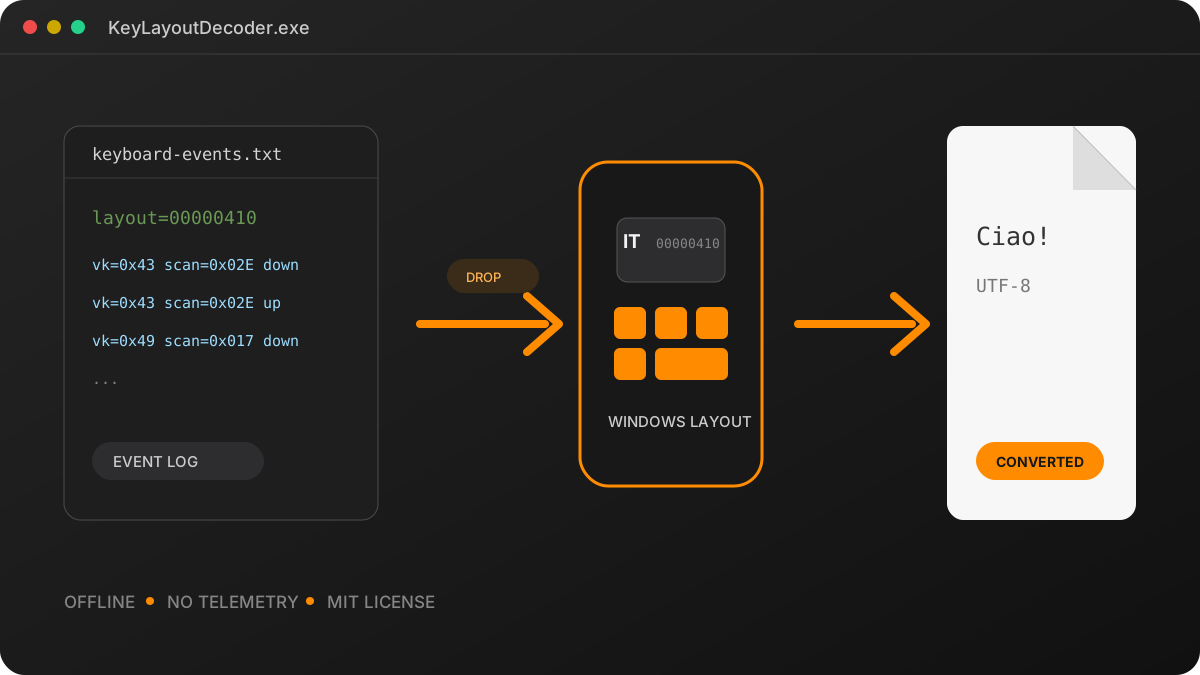
// Workflow
Drag, decode, read
- 01layout=XXXXXXXX
vk + scan + down/upProvide a supported event log - 02Win32 layout engineMap physical scan codes with modifiers
- 03<name>_converted.txtWrite UTF-8 text beside the original
// Decoder
What the utility actually reconstructs
Keyboard state
- Shift, Ctrl, Alt, AltGr, Caps Lock
- Dead keys and accented characters
- Layout-specific letters and symbols
- Enter, Tab, Backspace
File handling
- One or multiple files via drag and drop
- Optional quiet mode for scripts
- Original input left untouched
- UTF-8 output with BOM and Windows line endings
// Input contract
A small, explicit text format
| Element | Example | Meaning |
|---|---|---|
| First line | layout=00000410 | Installed Windows keyboard layout |
| Key press | vk=0x43 scan=0x02E down | Produces text or updates a modifier |
| Key release | vk=0x43 scan=0x02E up | Updates keyboard state |
| Malformed event | ignored | Does not stop the remaining conversion |
// Boundaries
Documented limits, without hidden behaviour
Installed layouts
The layout identifier in the log must exist on the Windows computer performing the conversion.
Initial toggle state
Caps Lock, Num Lock and Scroll Lock are assumed to be off because the input format does not store their initial state.
Extended flag
The E0/E1 flag is absent; recorded virtual keys compensate for Enter and numeric-keypad events.
Existing output
An existing file with the generated name is overwritten. Keep backups of any important result.
// Release & licence
Portable, inspectable and free
Offline by design
No network, telemetry, account, service or background keyboard capture.
MIT License
Source and documentation may be used, modified and redistributed under MIT terms while preserving the notice.
No third-party runtime
A statically linked C executable that depends only on standard Windows system APIs.
Unsigned build
Windows may display a reputation warning. The public release will include a SHA-256 checksum.